 GetPaid
When a Client Disputes the Work to Delay Payment
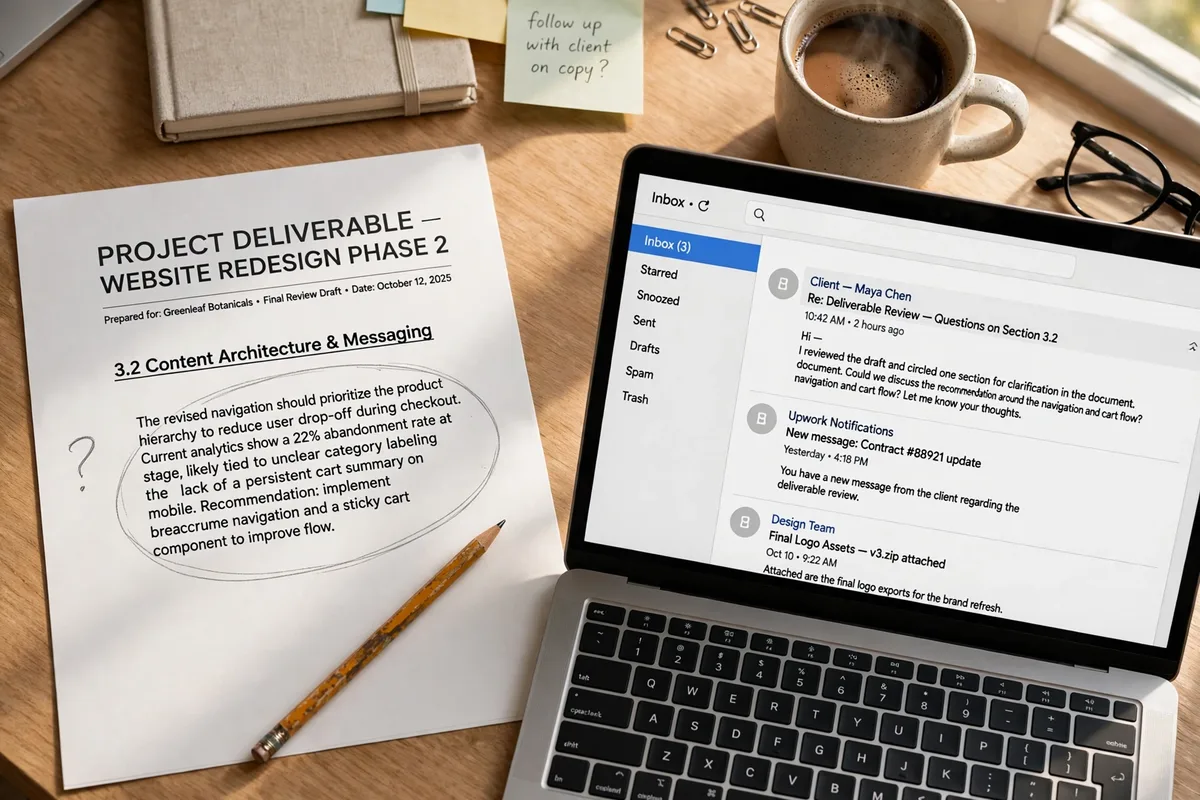
A complaint about the work is sometimes a complaint. Sometimes it is a delay tactic with better wording.
The project went well. You delivered on time, the client replied "this looks great," and you sent the invoice — $2,400, due in 14 days. On day 13, a different kind of email arrives. The work, it turns out, is "not quite what we expected." There are "some quality concerns." Payment, obviously, will have to wait until those are sorted out.
Nothing about the work changed between "this looks great" and day 13. What changed is that the invoice came due.
This happens often enough that it deserves a name and a procedure. A genuine quality problem is real, and it deserves a real fix. But a complaint that appears for the first time at the exact moment payment is due, stays vague no matter how many times you ask about it, and grows a new issue every time you answer the last one is not feedback. It is a stall — one that wears better clothes than "the cheque is in the mail," because it makes you sound like the unreasonable one for asking to be paid.
This article is about telling the two apart, and about the steps that resolve a real complaint without letting a fake one eat your invoice.
First, run the specificity test
You do not have to decide whether the client is honest. You only have to decide how to respond — and the response starts with one question: how specific is the complaint?
A real complaint is specific. It names the deliverable, the page, the paragraph, the file. "The pricing table on page 4 has the old prices, and the export is missing the column we agreed on." A client with a genuine problem can tell you exactly what is wrong, because they have actually looked at the work and found something. They usually raise it when they receive the work — not when they receive the invoice.
A delay tactic stays vague. "It's not quite right." "The quality isn't where it needs to be." "We're not fully happy with it." Press for detail and the complaint moves: answer the point about the layout and suddenly the tone is the problem; address the tone and now the timeline was disappointing all along. Each answer produces a new objection instead of a shorter list. That movement is the tell. A real problem shrinks as you work on it. A stall is designed never to shrink, because its purpose is not to fix the work — it is to keep the payment "under review" for another month.
There is a third signal, and it is the timing itself. Complaints raised during the project, at delivery, or during an agreed review period are part of the work. A complaint raised for the first time after the invoice is due — about work the client has already seen, used, or approved — is a payment event wearing a quality costume. Treat it that way: politely, in writing, and as a procedure rather than an argument.
None of this proves bad faith, and you should never accuse the client of it. You do not need to. The steps below work identically either way — which is the point. If the complaint is real, the steps fix it. If it is a stall, the steps end it.
Ask for the complaint in writing — specifically
Your first reply does two things: it takes the complaint seriously, and it makes the complaint specific. A vague objection cannot be resolved, and that is precisely why it stays vague. So ask, in one email, for the three things a real complaint always has:
Thank you for flagging this — I want to get it right. So I can fix exactly what needs fixing, could you send me, by [date, three business days out]:
- Each issue, listed separately, with the page, section or file it refers to.
- What "fixed" looks like for each one — the change that would close it.
- Anything on the list that was not in the original brief, marked as new, so we can handle it separately.
Once I have the list, I will confirm the same day what I will correct, and by when.
Watch what this email does. It is courteous. It assumes good faith. And it quietly removes every advantage a stall depends on: the complaint now needs a list, a deadline, and a definition of "done" — the three things a delay tactic cannot survive producing. A client with a genuine problem will send the list, usually with an apology for the delay. A client who was buying time will either go quiet, repeat the same vague sentence back to you, or object to being asked. All three of those responses are information, and you got it in one email instead of six weeks of chasing.
One rule while you wait: do not start fixing anything yet. Revising against a complaint that has not been written down means revising against a moving target, for free, while the invoice ages. The list comes first. Work follows paper, not the other way round.
Answer with the record, not with apologies
When the list arrives — or when the vagueness continues — your evidence is the project record, and for most freelance work it is better than you think:
- The brief or proposal the client agreed to, which defines what was promised.
- Approval messages. Every "looks great," "approved," and "go ahead and publish" is an acceptance, with a date on it.
- Delivery timestamps. When the files were sent, and how long the client held them before objecting.
- Sign-off points. If the client approved a draft, a design, or a first chapter, the final work that matches it was accepted in stages, not sight unseen.
- Use. If the work is live on their website, in their campaign, or in their product, it has been accepted in the most practical sense there is.
You are not building a court case. You are doing something simpler: moving the conversation from feelings ("we're not happy") to facts ("here is the brief, here is the approval, here is the delivery date"). Feelings can be argued with forever, which is why stalls live there. Facts have a much shorter argument. Reply point by point: for each listed issue, either "this differs from the brief here, and I will correct it by [date]" or "this matches the brief and the approved draft, here — so this one is a change, not a correction." That second category matters, and it leads directly to the next step.
This is also where the contract you signed at the start earns its keep. An acceptance clause — a defined review period, after which delivered work counts as accepted — turns this whole exchange into a formality. If your contract does not have one yet, the payment clauses every freelance contract needs are where it belongs: deposit, due date, late fee, pause-work, kill fee — and a review window with an end date.
Split the invoice: the undisputed part is due now
Here is the move most freelancers never make, and it changes the shape of the whole dispute. A complaint, even a real one, almost never covers the entire invoice. The client is disputing the pricing table on page 4 — not the other eleven pages. They are unhappy with one deliverable out of four. So separate the two:
While we work through the list, the rest of the invoice isn't in dispute — pages 1–3 and 5–12 match the brief and were approved on [date]. Please pay the undisputed $2,000 now, and we'll settle the remaining $400 against the corrected table.
This does three things at once. It gets most of your money moving. It shrinks the dispute to its true size, which is usually small. And it tests the client one more time: someone with a genuine, narrow complaint pays the undisputed part without blinking, because it costs them nothing to be fair. Someone running a stall will refuse — and a refusal to pay even the part they admit is fine tells you exactly what the "quality concerns" were for.
If part of the work genuinely is wrong, say so plainly and fix that part. Conceding the real 10% is not weakness; it is what makes your position on the other 90% unarguable.
Offer two doors — both of them end in payment
Once the list is answered and the undisputed part is moving, the dispute has exactly two honest endings. Put both in writing and let the client choose:
Door one: pay, and the corrections happen under the agreement. The invoice is paid in full. The items that genuinely differ from the brief get corrected — that is what a correction is, and it was always included. Anything beyond the brief is quoted as new work, at your normal rate, with its own invoice.
Door two: pay, then talk about changes. If the client wants the work to be different rather than fixed — a new direction, a different tone, extra sections — that is a new engagement. It starts after this invoice is settled, with a deposit, like every project that starts from a position of trust.
Notice what is not on the list: a door where you redo the work for free and the invoice gets paid afterwards, if the redo is approved, whenever that may be. That door is the subject of the next section, because it is the one the stall is steering you towards.
Framing it this way is not a threat, and it does not need firm language. You are simply describing how the work works: corrections fix what was promised; changes buy something new; and both happen on top of a paid invoice, not underneath an unpaid one.
Do not let "fix it first, then we'll pay" become the deal
The stall has one destination: an arrangement where payment is conditional on revisions, and the revisions have no agreed end. Accept it once and the arithmetic turns against you fast. The first free round takes a week. The verdict comes back — still not quite right, two new points. The second round takes another week. Meanwhile the invoice is 45 days old, you have done the project one and a half times, and the client has spent nothing and risked nothing. Every incentive points the wrong way: delay costs them nothing and earns you nothing, so delay is what you get.
The fix is not refusing to correct real mistakes — fix those, promptly and without sulking; your reputation is worth more than the argument. The fix is refusing the sequence. Corrections of genuine errors are part of the original job and can happen in parallel with payment. They are not a toll booth the invoice has to pass through. And revisions — work beyond the brief — are never the price of being paid for work already delivered and approved. The moment "we'll pay when it's fixed" is on the table, the reply is some version of: "I'm happy to correct anything that differs from the brief. The invoice for the delivered work is due on [date], and I'll start the corrections the same week — the two run together."
If a client will only pay after free rework, with themselves as the sole judge of when the rework is good enough, they are not describing a quality standard. They are describing a discount they intend to take in your hours instead of your rate.
When the dispute is just the newest stall
Sometimes you run the whole procedure — the request for specifics, the record, the split, the two doors — and nothing moves. The list never arrives, or it arrives and dissolves, or every answer produces a fresh objection. At that point the dispute has told you what it is, and you stop treating it as a quality conversation. It belongs to the same family as the classic stall phrases — "it's with accounting," "we're just waiting on sign-off" — and it gets the same treatment: what to do when a client doesn't pay, the escalation ladder of reminders, a final notice, and a deadline that means something.
Keep the file as you go: the brief, the approvals, the delivery record, your request for the list, their replies. If the amount justifies it, that file is exactly what small claims and collection agencies will ask you for, and a documented dispute — one where you asked for specifics, answered with evidence, and offered fair doors — is far stronger than a bare invoice with a complaint hanging off it. This is general information about handling a dispute, not legal advice; how a contested invoice is treated depends on your contract and on where you and the client are.
And name the worst case honestly, because it is part of the procedure too: a determined client can drag a vague dispute out for months, and some invoices disputed in bad faith are never paid without a fight that costs more than the invoice. The procedure above does not guarantee payment. What it does is collapse the timeline — weeks instead of months to find out whether you are dealing with a problem or a tactic — and leave you with a record that makes the next step, whichever it is, as strong as it can be.
Set this up before the next project
Every step above is easier with three lines in the contract, agreed while everyone is still friendly:
- A review period with an end date. "You have seven business days from delivery to raise any issue with the work. After that, the work is accepted and the invoice is payable in full." Most genuine complaints surface within days. A deadline does not block real feedback — it blocks feedback invented at invoice time.
- Corrections defined, changes priced. "Corrections fix anything that differs from the agreed brief, at no charge. Changes to approved work, and anything outside the brief, are quoted separately." One sentence each, and the two-door conversation above never has to be improvised again.
- Revisions counted. If your work includes revisions, name the number — two rounds, say — and what a round means. An unlimited revision clause in the hands of a stalling client is an unlimited delay clause.
None of this signals distrust. Clients who intend to pay barely notice these clauses, because for them the review period is just the week they were going to spend reading the work anyway. The clients who push back on an acceptance deadline are telling you, before you have done any work, how they plan to behave after you have done it. Believe them early, and price the risk — or walk away while walking away is still free.

Steal the exact words
Free sample: 3 late-payment email templates + the invoice checklist that gets invoices paid right the first time.
Want the whole system — all 12 templates, the contract clauses, late fee wording, and deposit scripts? That's The Get Paid Pack.
FAQ
The client says the work is bad, but won't say what's wrong with it. What do I do? Ask for the list, in writing, with a date on it — each issue separately, and what "fixed" looks like for each. A complaint that cannot be listed cannot be corrected, and it should not be able to stop a payment either. If no list arrives by the date you set, treat the invoice as a plain late payment and follow the normal reminder steps.
Should I fix genuine mistakes before or after I'm paid? Fix them — but in parallel, not as a precondition. Correcting what genuinely differs from the brief is part of the original job, and doing it promptly strengthens your position on everything else. What you should not accept is the sequence "rework first, payment later, judged by the client alone," because that sequence has no end built into it.
The client approved the work, then disputed it after the invoice arrived. Does the approval matter? In practice, yes — it is the strongest thing in your file. An approval message with a date on it, especially one followed by the client using the work, shows the work was accepted as delivered. Point to it calmly and specifically: "This is the draft you approved on [date]; the delivered version matches it." It does not end every argument, but it moves the argument onto ground where the client has to explain the change of mind — and "we changed our mind" is a change request, not a correction.
Can a client legally refuse to pay because they don't like the work? It depends on the contract and on where you both are, and this article is general information, not legal advice. As a practical matter, "not liking" delivered work that matches the agreed brief is a much weaker position than a specific, documented failure to deliver what was promised — which is exactly why the procedure here pushes every complaint towards specifics and paper. For a large amount, a short consultation with a local lawyer costs less than a month of vague emails.
How much of the invoice should I ask them to pay while a dispute is open? All of the part that is not genuinely in dispute. If one deliverable out of four is contested, the other three were delivered and accepted, and their share of the invoice is due on the original date. Splitting it this way is fair to a client with a real complaint — and it is the fastest way to find out whether the dispute was ever really about the work.
What if I look at the complaint and the client is actually right? Then fix it, say so plainly, and do not charge for the correction. Conceding a real error costs you a few hours and buys you the standing to be immovable about the rest: the undisputed part, the payment date, and the difference between a correction and a change. The procedure in this article is not about winning every point. It is about making sure the points are real.
Steal the exact words
Free sample: 3 late-payment email templates + the invoice checklist that gets invoices paid right the first time.
Want the whole system — all 12 templates, the contract clauses, late fee wording, and deposit scripts? That's The Get Paid Pack.
Read next

6 Payment Clauses Every Freelance Contract Needs
Six clauses — deposit, due date, late fee, pause-work, kill fee, and payment method — with sample wording you can copy into your next contract.

What to Say When a Client Says "The Check Is in the Mail"
Six stall phrases, decoded — with the exact reply that turns 'it's being processed' into a payment date you can hold them to.

What to Do When a Client Doesn't Pay: A Step-by-Step Escalation Guide for Freelancers
A step-by-step escalation ladder for when reminders stop working — from a friendly nudge to a final demand letter and beyond.